

A tummy tuck by itself does not fix a hernia, but a hernia can often be repaired during the same operation. While a tummy tuck removes loose skin, tightens separated stomach muscles, and slims the flanks, a hernia is a defect in the abdominal wall that requires its own dedicated repair. Because a tummy tuck already exposes the abdominal wall, it is one of the most convenient times to address a hernia at the same time.
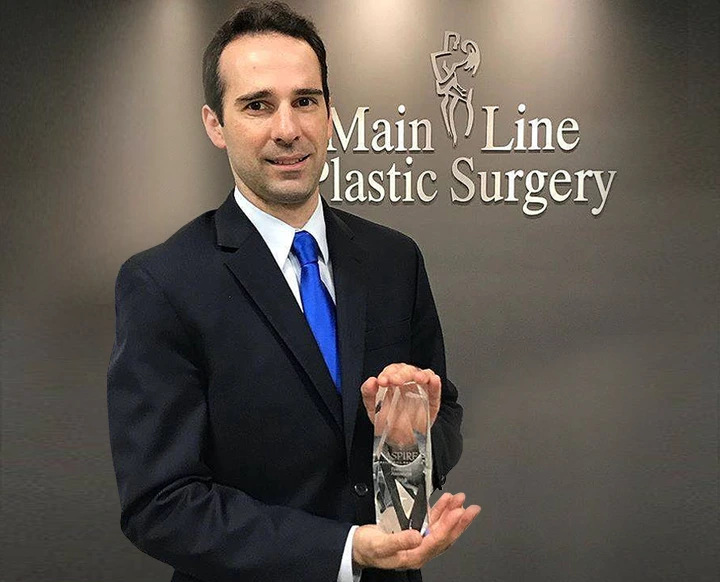
At Main Line Plastic Surgery in Bryn Mawr, PA, Dr. Raymond D. Jean evaluates the abdominal wall at every tummy tuck consultation so nothing gets overlooked.
A tummy tuck, or abdominoplasty, creates a flatter, firmer stomach when diet and exercise have stopped making a difference. At Main Line Plastic Surgery, a full tummy tuck includes three components:
Removal of loose skin and stubborn fat
Tightening of the stretched abdominal muscles (diastasis recti)
Belly button repositioning
A hernia happens when an internal organ or fatty tissue pushes through a weak spot or opening in the abdominal wall. You may notice a soft bulge that grows when you cough, strain, bend, stand, or lift – and sometimes disappears when you lie down. Hernias can cause discomfort, pressure, or a dragging sensation, and they do not heal on their own.
Hernia vs. diastasis recti: Diastasis recti is a widening and separation of the abdominal muscles, common after pregnancy – not a hole. A tummy tuck directly corrects diastasis by stitching the muscles back together. A true hernia requires its own repair.
Umbilical hernias – at or near the belly button; extremely common after pregnancy and significant weight changes.
Ventral hernias – a general term for hernias along the vertical midline of the abdomen, from a previous surgery or a natural weak spot.
Incisional hernias – through the scar of a previous surgery, such as a C-section, hysterectomy, or open abdominal operation.
Epigastric hernias – in the midline, between the belly button and the breastbone.
During a tummy tuck, the skin and fat are lifted off the abdominal wall so the muscles can be tightened. That same exposure gives clear access to the fascia – exactly where a hernia repair takes place. Because the surgeon is already working in that field, repairing the hernia is a logical and efficient step.
Small to moderate umbilical, ventral, epigastric, and some incisional hernias are the ones most commonly repaired at the same time. These sit within the surgical field already opened for the abdominoplasty, so closing them adds relatively little to the operation.
Larger or more complex hernias – wide defects, prior mesh, recurrent hernias, or bowel involvement – may require a general surgeon’s involvement and a different plan. In some cases, the hernia is repaired first, and cosmetic contouring is staged afterward.
Dr. Jean’s background includes a General Surgery residency at the University of Pittsburgh Medical Center followed by a Plastic Surgery residency at Loma Linda University Medical Center, along with experience in thousands of cases. This background makes him a competent surgeon who can address both the abdominal wall and the skin envelope above it.
Keep expectations realistic. A tummy tuck is a contouring operation. It:
Does not close a hernia defect unless a hernia repair is specifically performed
Does not substitute for weight loss
Does not guarantee a hernia will never return, since abdominal wall repairs can recur with heavy strain or major weight gain
If your bulge is a hernia and your priority is health rather than shape, hernia repair is the operation that addresses it. During your in-person consultation at our Bryn Mawr office, Dr. Jean will examine the size and nature of your hernia to determine the safest, most effective approach.
One anesthesia, one recovery. Instead of two operations with two downtimes, you heal once.
One incision. The bikini-line abdominoplasty incision provides the access needed, so there is no additional visible scar in most cases.
A better final contour. Correcting the hernia and tightening the muscles together produces a flatter, more even profile than either step alone.
A coordinated plan. Muscle tightening, hernia closure, and flank liposuction are designed as one operation, not layered on top of each other.
Cost-effectiveness. A single combined surgery is generally more affordable than two separate procedures with separate anesthesia and facility fees.
Suture repair: Smaller hernias are closed with strong, durable stitches that bring the edges of the fascia together.
Mesh repair: Larger defects – or areas where tissue is thin or has failed before – may be reinforced with surgical mesh, which acts as a scaffold and distributes tension across a wider area.
Which approach makes sense depends on the size of the defect, the quality of surrounding tissue, whether the hernia has been repaired before, and your body type and activity level. This decision is made during your in-person evaluation, not from a photo or a phone call.
Your combined procedure is performed at a state-accredited surgery center with a board-certified anesthesiologist ensuring your safety and comfort. Dr. Jean typically repairs the hernia first, then proceeds with muscle tightening, skin removal, and contouring.
Most patients need about two weeks of downtime, returning to a desk-type job at the beginning of the third week. Strenuous activity and heavy lifting are restricted for at least four to six weeks so the muscle and hernia repairs can heal. Adding a hernia repair may extend restrictions on lifting and core strain, so follow your specific instructions closely.
All stitches used are dissolvable – there is nothing to have removed.
Your first follow-up visit is scheduled one week after surgery.
Wear your compression garment as directed; it helps with swelling and comfort.
Avoid heavy lifting and straining, including constipation-related straining. Stay hydrated and keep moving gently.
You can text the office with questions or concerns any day of the week.
Most patients notice two changes at once: the bulge is gone, and the abdomen looks flatter and tighter. Swelling settles over several weeks to months as the final contour refines. Results hold up well when weight stays stable, and core strain is reintroduced gradually – leaving you with a stronger core and renewed confidence.
Ideal candidates are healthy, non-smoking individuals at or near a stable weight, bothered by a combination of loose abdominal skin and a diagnosed hernia, with realistic goals. Future pregnancies should be complete, as pregnancy can re-stretch the muscles and skin and compromise results.
Every patient is medically screened before surgery. If the anesthesiologist has concerns, clearance from your primary care physician is required – and if a case is not safe medically, it is not scheduled. Depending on how much loose skin you have, a full abdominoplasty, a mini tummy tuck, or another body procedure may be the better fit.
A tummy tuck alone does not close a hernia, but a hernia repair can usually be performed during the same surgery, often through the same incision, with one anesthesia and one recovery. Umbilical, ventral, epigastric, and some incisional hernias are the most commonly combined cases; larger defects may need a staged or coordinated plan. The only way to know which applies to you is an in-person evaluation with Dr. Raymond D. Jean in Bryn Mawr, PA.
About the Author
Dr. Raymond Jean
August 13, 2026